George Washington by Ingri & Edgar D’aulaire Free Copywork

Want your kids to learn about the father of our country? The book George Washington by Ingri and Edgar D’aulaire is a beautifully illustrated resource that will help you do that. This free copywork, carefully selected from the book, will pair nicely with D’aulaire’s book as you read it with your kids.

George Washington by Ingri & Edgar D’aulaire
Best known for their award-winning illustrations, Ingri and Edgar D’aulaire introduce us to George Washington, a young boy in early colonial Virginia. As a boy, George loved to measure the land around Mt. Vernon and draw maps of his findings. He wanted to go farther into the frontier to map out the Indian territory. He was able to do just that when Lord Fairfax hired him to be one of his surveyors. With the other surveyors, George helped measure and map most of the land of Virginia.
Following in his brother Lawrence’s footsteps, he later became an officer. He protected the Virginia backwoodsmen when the French and Indians tried to drive them off their land. After the French and Indian War, George returned home to Mount Vernon, where he married Martha and enjoyed home life on his plantation.
After several years, troubles arose between the American colonists and the English King George. As tensions mounted, Americans asked George Washington to be their commander-in-chief of the military. Although his soldiers were farmers and hunters, George trained his army well. Through many difficulties, including the dismal winter at Valley Forge, he led the Americans to victory and Lord Cornwallis finally surrendered at Yorktown.
After this, Americans asked George to be the country’s first President. Although he preferred to be a country farmer, he willingly accepted and became, ever after, the Father of our country.

What is Copywork?
Copywork is simply the practice of handwriting quality pieces of literature in a book or collection.
Copywork was also practiced in past centuries as part of a classical education. Charlotte Mason, who is often credited as the originator of copywork (she called it transcription), was deeply rooted in classical educational philosophy.
“The principles and methods Charlotte Mason advocated, however, were not of her own invention. She herself said that she and her colleagues had ‘discovered’ them, because they represent universal truths about education that have their roots in the classical world.” (Consider This, p.9).
Interestingly enough, one section of this book mentions George Washington writing his rules of civility in his copy book. He lived many years before Charlotte Mason’s educational reforms, but his copy book is evidence that copywork has been used for many centuries to teach children to write.

FAQ About Copywork
If you are new to copywork, perhaps these answers to common questions will help you.
How often should my child do copywork?
Every day! When a child regularly practices copywork over a couple of years, they begin to understand how words flow together, how sentences are structured, how dialogue should be punctuated, and so much more. They absorb clear ways of expressing thought.
How do I begin teaching my child to practice copywork?
A child should be able to write a sentence fluently before beginning copywork. (It should take no more than 5-10 minutes for him to copy a sentence.) For very young children, I start by hand-writing the sentence myself on dashed-line paper, skipping lines so that they can copy below my writing.
How can I know how much my child should copy?
I like to have our kids copy one sentence for first grade, two sentences for second, three sentences for third, etc. This will vary, of course, based on the developmental level of each child, but if it’s taking an elementary child more than 10-15 minutes to write their copywork, it’s probably too much.
What Skills Are Covered In Copywork?
- Handwriting/Cursive (if required)
- Spelling
- Punctuation
- Vocabulary
- Writing Form
How Can I Know if My Child is Learning These Skills Through Copywork?
One of the most important parts of copywork is checking their work. If no one is checking a child’s work, they will likely miss many learning opportunities.
When I check our kids’ copywork, I first have them read it back to me. Next, I circle and discuss the mistakes they have made. I have them correct their work. If a word is misspelled, I have them rewrite it 2-3 times beneath.
(For more on Spelling, see this post. How I Teach Spelling Without a Formal Curriculum.)

How We Use Copywork With This Book
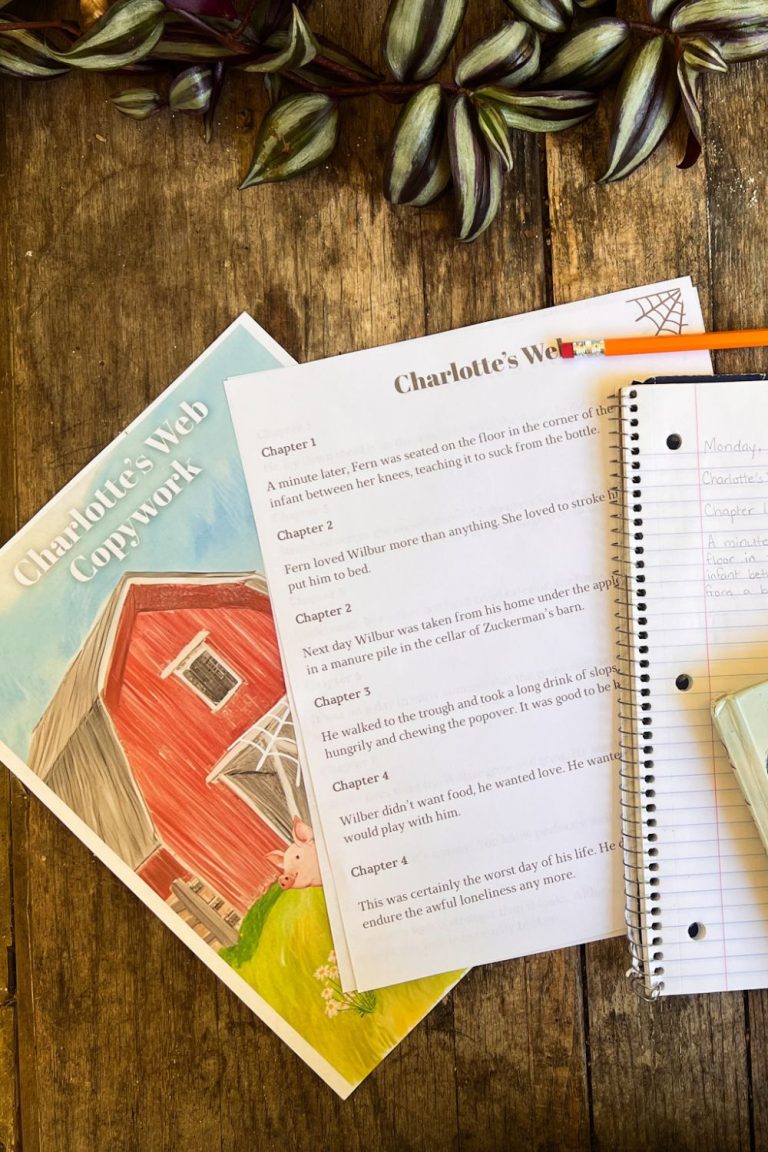
You can use this copywork however you wish, but here is how we use it in our home. I like to read a few pages a day to my child and have the child copy the copywork that matches those pages.
Each selection is 1-2 sentences long, so it is designed for a child in first or second grade. You can also assign a child to read the book on their own and follow the same pattern.
I print the pages, put them in slipcovers, and place them in a 3-ring 1/2-inch notebook. With kids who have difficulty focusing, I will often use a dry-erase marker to box the section that they are supposed to copy that day. This is also helpful if you don’t want them to go through all the copywork, but prefer them to copy certain selections.
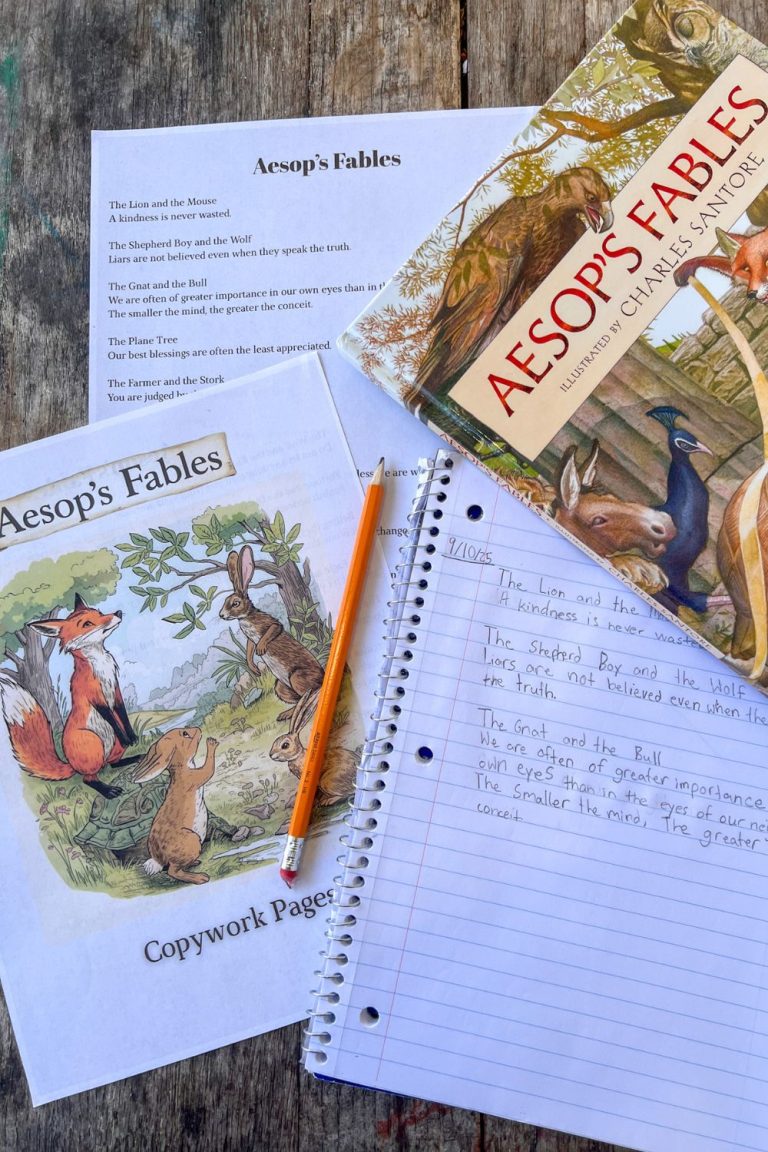
I have our kids write the short form of the date in the margin on the left and the copywork passage beside it, skipping lines between different copywork days.
More Copywork Resources
You can find more free copywork to use in your homeschool on the blog!
Copywork from Literature
These blog posts have copywork from other excellent books!
D’aulaire’s Abraham Lincoln Free Copywork
James Herriot’s Treasury For Children Copywork
Fifty Famous Stories Retold Copywork
Little House In the Big Woods Copywork
What’s Included in the George Washington (by Ingri & Edgar d’Aulaire) Free Copywork
This free printable has 2 pages of copywork from George Washington by Ingri & Edgar d’Aulaire. Each selection highlights important parts of George Washington’s life. The passages are 1-3 sentences long, so it will be a good fit for elementary-age kids.

How to Access the George Washington (by Ingri & Edgar d’Aulaire) Free Copywork
Enter your email in the box below to access the George Washington by Ingri & Edgar d’Aulaire Free Copywork from our free homeschool printable library.
(If you are already a member, log in to the Homeschool Library to access your printable copywork!)
Join the free Homeschool Library and get access to an ever-growing collection of homeschool resources—all in one easy place.
I continually add new copywork from literature to this library, so come back for more free copywork.
Also, leave a comment below to let me know which books you would like me to add to the free copywork library.
Other George Washington Books
Do you and your kids know these interesting facts about George Washington?
- He wrote a list of 110 rules of civility or proper behavior for gentlemen.
- Washington is pictured on Mount Rushmore.
- He fought in two wars. (The French and Indian War and The American Revolution)
- He had lifelong tooth problems.
- He is featured on the dollar bill.
Learn more about the father of our country by reading more about him! This carefully selected book list will help you find the perfect book to help you introduce your kids to our first President.
Blog Post: 10 Fantastic Books for Kids About George Washington




I have two copywork questions, if you don’t mind.
1. You mentioned corrolating numbers of sentences to year of schooling. Is there an upper limit? Is the sixth grader doing six sentences?
2. How long does copywork continue? At what grade do they stop, and what do they transition to instead?
Thank you for all you put out for us first generation homeschool moms!
Sure!
As kids get older, I hold the sentence number rule more loosely. It should be about a half a page or take them about 10-15 minutes to write. You can use your own good judgment as a parent if you think it is too little or too much. It should challenge them, but not overwhelm them.
I usually have our kids do copywork through about 7th or 8th grades, however, they can continue it into high school if they want. It’s such a great practice, even for adults! (I copy Scripture every day to help me remember passages.) As our kids get into high school, we have had them take writing classes at our co-ops so they can get feedback and input from others. It’s not necessary, but it’s what we have done. If I wasn’t doing that, I would probably look into IEW or having our kids continue with narration, journaling (commonplace notebook/nature notebook) along with writing some additional assignments that are useful (resume, application, marketing a product, etc.)